Monday, 17 December 2012


Friday, 16 November 2012
60th birthday: Ibori Greets Alamieyeseigha From UK Jail
From a UK jail, where he is doing time for corruption, came birthday greetings from former Delta State governor, James Ibori to disgraced ex-governor of Bayelsa State, Diepreye Alamieyeseigha.
Alamieyeseigha, who was governor in Bayelsa from 29 May 1999 to 9 December 2005, and was convicted for corruption, clock 60 years today.
In a congratulory advertorial he took out in the Vanguard edition of today 16 November, Ibori showered effusive praises on Alamieyeseigha, who he described as the “Governor-General of The Ijaw Nation”.
In the birthday message signed by him, Ibori wrote: “My brother, please accept my hearty congratulations to you as you turn 60 today
“I join your numerous well-wishers to thank the good God who has kept you alive despite the vicissitudes of life – the lies and ill-treatment – that came your way just because of crass debilitating politics,” wrote Ibori.
The subdued former Delta strongman continued his adoration of Alamieyeseigha: “Yet, I know that you will take solace in the fact that the people of the Ijaw nation, whose cause you championed ever so lustily, have never forgotten what you stood for and the dangers you embraced while fighting for their higher good and fiscal federalism for Nigeria.”
Ibori added: “One day the right questions will be asked, the right answers buried deep in heaps of lies will be unhearted and Nigeria’s contemporary history, in which you starred, will be better appreciated and events put in their true perspective.”
Ibori is currently serving a concurrent 13-year jail term in a UK jail, after his conviction by a Southwark Crown Court, on 17 April this year, for money laundering offences.
The celebrant, Alamieyeseigha, also earlier bagged prison sentences, after admitting to pilfering his state’s funds. His predicament began in September 2005, when he was detained in London on charges of money laundering.
When the London Metropolitan Police searched his London home, they found about £1m in cash. A further search by the Met yielded a total of £1.8m in cash and bank accounts.
Alamieyeseigha, who was also found to own an estimated £10m worth of real estate in London, later jumped bail in the UK in December 2005, by allegedly disguising himself as a woman, though he later denied the claim.
But the ex-governor of Bayelsa was eventually jailed in Nigeria on 26 July, 2007, after he pleaded guilty to six counts of corruption, in a plea-bargaining deal.
He was sentenced to two years in prison on each count, but, because the sentences were to run concurrently, and the almost two years he earlier spent in detention while standing trial were deducted, Alamieyeseigha walked out of prison a free man a day after his conviction.
The ex-convict’s assets, including four luxury UK properties, one of them which he bought for about £1.7m cash in one day, were ordered to be forfeited to the Bayelsa State government.
Also on 28 June this year, the United States Department of Justice executed an asset forfeiture order on the sum of $401,931 in a Massachusetts brokerage fund, traceable to Alamieyeseigha.
Alams, as he is otherwise known, is now back in the scheme of things, hobnobbing with Presidency top shots, especially President Goodluck Jonathan his kinsman and former deputy while he was governor, who is believed to have rehabilitated him.
Justice Eso’s last interview: ‘Why plea bargain breeds corruption’
October 23, 2011.
* Says woe unto corrupt judges
*’True federal system, the way forward’
Justice Kayode Eso needs no introduction. For a man whose career as a legal mind spanned about four decades with meritorious alacrity, this former Justice of Nigeria’s Supreme Court will never change.
With what some have described as a caustic tongue, especially when delivering judgments, at 86, retired Justice Eso did not disappoint Sunday Vanguard in this interview.
Sharp-minded, morally upright, Eso is your quintessential legal mind per excellence.
Recently honoured during the Hallmarks of Labour Awards, Eso says “I felt happy and fulfilled when I received the letter telling me about the award. And I thought that all my labour has not been in vain. That whatever, I have been doing in the judiciary has not been in vain. That is the way I felt”.
But on the many ills confronting the Nigerian nation, the erudite justice lamented the sorry state of the judiciary, expressed angst at the concept of PLEA BARGAIN, felt insulted by the conciliatory approach of the federal government on the Boko Haram issue and concludes by saying that if Nigerians wants to make progress as a nation, true federalism is the way forward. He insists that the attempt to amend the Nigerian constitution would end up as a fools errand because it would not address the real issues.
When you were still in active service in the judiciary, people applauded you for standing against corruption. But today, it seems the system has changed and what you hear today is that the judiciary is very corrupt. How do you feel when you hear this knowing your hard stance against corruption?
When I was in the judiciary, I stood up against corruption; and when I left the judiciary, I still stand against corruption.
So till now, I still stand against corruption.
I am not happy to have a corrupt bench. It is a deadly thing.
You see, the judiciary is the only hope of those who do not have money to push their ways around. Judiciary is the yardstick of the situation in the country.
Even investors look at the judiciary of a nation before taking their money to that nation. If an investor believes he cannot get justice in a country, he would not invest.
In any event, it is an honour for anybody to be appointed a judge.
If you are appointed a judge, you should not corrupt that system at all. It is woe unto anybody to corrupt the course of justice. I do hope that we will find a way to stamp it out.
 As an experienced judge, what do you think we can do to get out of a corrupt judicial system?
Well, let me say at this stage that the present Chief Justice of the country has identified the issue of corruption as one of the things he must deal with.
He intends to set up a committee to look into the issue. (He has already done that)
The committee will be meeting very soon. I believe, this week. I happen to be a member of that committee therefore, I cannot talk more about it. I won’t, I won’t say anything that would prejudice the noble attempt of the present honourable Chief Justice of the country.
First of all he wants us to advise him on how to tackle corruption on the bench and to find a way of stamping it out. I’m ready to support him on that.
What is the most interesting case that you ever tried and which one was the most difficult sir?
No case is difficult at all once it is in pursuit of justice.
That is the truth about it.
In justice, one case is as good as the other.
I cannot really think of anyone that gave me a kick after. The only one I can say gave me a kick is the case of Awolowo versus Shagari.
I stood firmly to say that you cannot break up a state to have a unit of that state and that when you have 19 states and you are looking for the two-thirds of that, you cannot really get the two_third of that state.
Please explain what you mean?
It is simple: How do you get the two-thirds of a state? I thought it was silly for anybody to conjecture that. How it gave me a kick was that as soon as I delivered the judgment, which, of course, was in the minority, the constitution was amended.
After the amendment, how did that feel – vindicated, satisfied?
That gave satisfaction.
It is the opinion of the public that it is because the allocation of the judiciary comes from the executive that is the judiciary cannot be completely independent. What is your opinion on this?
The judiciary should not only be independent but it should also be economically be independent of the executive. It should not rely on the executive for money to flow through the system. No. it is not good enough. When you have the admixture of the judiciary with the executive, you are only putting the judiciary as an appendage of the executive, that cannot be right.
Ordinary Nigerians today see Justice Salami as a victim of the clique of people who are bent on destroying the judiciary?
On the Justice Salami case, it is in court. I’m a disciplined judicial officer, though retired. When a case is subjudice, it is not right to comment on that case. What I would say is that the matter would still have to be determined by a court, so I would rather not air my view, though I have my own view. I cannot state my view because it would still be determined by a court. So, let us wait for the determination of the court.
Penultimate week some ex-governors were arrested by the EFCC for alleged stealing of N101 billion. If just three persons could allegedly take as much from the state resources, what is then left for other ordinary Nigerian to spend?
It is still an allegation and I, as a judge, I always like to listen to the other side.
Let us see what their defence is.
The allegation is that they have looted the nation to the tune of N101 billion.
If it is correct, they should be punished. The problem with Nigeria is about the type of punishment meted out.
This notion of coming out and talking about plea bargain is something else.
They bargain with the judge, bargain with the accused person, he returns half of the money, and then they give him some hairy-fairy punishment – go and serve three months in prison and the three months, will, of course, be in the hospital.
This is an encouragement for other governors to steal when they come into office. There is no plea bargain in our law.
The importation is wrong.
To me, it is corruption to bring plea bargain into the law of Nigeria.
Look at the issue of Igbinedion in Edo State who was alleged to have stolen billions and billions of naira. They said they had this system of plea bargain.
They asked him to plea bargain, there and then he was fined three million naira which, he picked out of his purse and paid there.
It sent a notion that it had been pre_arranged that it would not be more than three million. Now, after that they started to gloat and shed crocodile tears and said the punishment was not adequate.
Of course, the punishment can never be adequate when they import this issue of plea bargain.
But, let us say the issue of plea bargain was not introduced and he was punished as he deserved, others would learn.
Years back, I was saddled with the case of Oba Akran and Ademiluyi – Oba Akran was the Oba in Badagry, and Ademiluyi was the chairman of the biggest corporation in the country, they were alleged to have stolen 500 pounds.
They appeared before me and I gave them seven years after I had found them guilty. They wrote to the Supreme Court because there was no Court of Appeal then, their appeal was dismissed. That was justice not this way of palliating people, rubbing them with oil in the name of plea bargain.
Plea bargain is actually not our law.
And they come around and say it is done in other countries, Nigeria is not any other country. Nigeria is Nigeria not just any other country. In other countries, it may be right for them to have plea bargain. We never had plea bargain.
It is corruption for anybody who imports plea bargain into our law.
Looking at the damage and backwardness this issue of corruption has brought to this country, would you subscribe to capital punishment for those who plunder the resources of this country like it is done in Asian countries where they kill them?
No, I do not believe in capital punishment.
It is better to punish somebody and make the person live to get the pains of that punishment.
For instance, somebody who has stolen billions of naira, let them give him proper punishment and let him forfeit all his property.
Let him live in penury and let him see the difference between his stolen affluence and what actually he should be.
Is our constitution just a book given to us by the military or a book we are just living with?
The 1999 constitution lied about itself when it says we Nigerians. We Nigerians never did it but soldiers and half-baked lawyers among them sat down and wrote the constitution for us.
1999 constitution is not a constitution of this country, we should have a real constitution of this country. When you start to patch the constitution like we are patching now, we can never be there. Why are we shying away from a Constituent Assembly.
Things should not be done half way. Go all the hog.
Boko Haram has caused deaths of thousands of Nigerians. Some people are calling for dialogue with this sect. Even, government is considering amnesty for them. Do you support amnesty programme for this deadly and violent sect?
You dialogue with people you know.
Do they know who Boko Haram people are? If they know, they should arrest them. Give them amnesty for what. People are killing and you want to give them amnesty even without trying them. I do not believe in what is going on at all. These people are a menace not only to this country but to the whole world. They have given the picture of Nigeria as a failed nation that cannot even deal with security within its borders. If we have that system, we are only creating problem for ourselves and our children because once the investors believe that there is no security, they would not come with their money. And if we don’t have investors in this country, we cannot exist. Coming round and say we want to dialogue with them, dialogue with who?
Some people say let us give Boko Haram amnesty and Boko Haram say, no we don’t want amnesty. What are they saying?
In other words, they are challenging the government. Do we have a parallel government of Boko Haram?
Why don’t we arrest them? Why don’t we deal with them? Who are they? Why are they being palliated? These are the issues we should find out. Who is Boko Haram or who are Boko Haram? Who are behind them?
They went to the UN building and destroyed it, killed people. UN would not be happy with that at all and I believe they are removing their stand in Nigeria and taking it to Senegal. If that is the case, then we are a big loser in this country.
It is a failure if we don’t stamp out Boko Haram in a correct way.
The correct way is to arrest them and take them to court. It is laughable that we are giving amnesty to those who are killing us.
I don’t understand what is going on. May be it is because I’m not a politician. May be they would understand.
The political situation in the country is funny; what’s your take on that?
Things seem to be stagnant in terms of the economy.
In terms of politics, I’m not a politician, but as an observer, my candid opinion is, wait and see.
The president has just mounted the throne. Let us see, let us give chance to see how he is going to do it. The state of the nation is muddled. Let us see how he intends to pull the nation out of the muddle. That is all I can say. There is no doubt that we got it wrong, but we have a president there now. Let us give him time. Let us not judge him. I do not want to judge him before he performs. And I’m prepared to give him some time.
What is your opinion on federalism? At 86, you have seen it all, especially when compared to fiscal federalism as practised during the First Republic?
To me, we are not practising federalism in this country at all and this is what we should practise.
The west was governed by Chief Obafemi Awolowo for the federal system status. There was no question of being unitary which is what we are patching up now and calling it federal system. This country will only succeed if we practise true federalism.
The way we are being ruled, the states go cap in hand begging the Federal Government for money to develop the state and majority of those states stay poor – and in some instances, the President gets to blackmail some state governors?
It is because we are not practicing federalism at all.
The states should not go cap in hand to the Federal Government. If we have true federal system, there should be enough for all the states to spend. The issue that would be decided by the FG would be so minimal.
Some people suggested that we should go back to the regional system that we practised before?
I would advocate six provincial system.
That would be better because if you have federal system and you have 36 states, that would be very difficult. Already, we have six geo-political zones; have each zone as a federal unit. Then, we can have a true federal system and until we do that, we are just deceiving ourselves.
How do you feel about the award you are being conferred with?
I felt happy and fulfilled when I received the letter telling me about the award. And I thought that all my labour has not been in vain. That whatever, I have been doing in the judiciary has not been in vain. That is the way I felt.
Sir, people still wonder that at 86, you still look agile and sound. What is the secret?
It is God. Nothing else but God and discipline!
* Says woe unto corrupt judges
*’True federal system, the way forward’
Justice Kayode Eso needs no introduction. For a man whose career as a legal mind spanned about four decades with meritorious alacrity, this former Justice of Nigeria’s Supreme Court will never change.
With what some have described as a caustic tongue, especially when delivering judgments, at 86, retired Justice Eso did not disappoint Sunday Vanguard in this interview.
Sharp-minded, morally upright, Eso is your quintessential legal mind per excellence.
Recently honoured during the Hallmarks of Labour Awards, Eso says “I felt happy and fulfilled when I received the letter telling me about the award. And I thought that all my labour has not been in vain. That whatever, I have been doing in the judiciary has not been in vain. That is the way I felt”.
But on the many ills confronting the Nigerian nation, the erudite justice lamented the sorry state of the judiciary, expressed angst at the concept of PLEA BARGAIN, felt insulted by the conciliatory approach of the federal government on the Boko Haram issue and concludes by saying that if Nigerians wants to make progress as a nation, true federalism is the way forward. He insists that the attempt to amend the Nigerian constitution would end up as a fools errand because it would not address the real issues.
When you were still in active service in the judiciary, people applauded you for standing against corruption. But today, it seems the system has changed and what you hear today is that the judiciary is very corrupt. How do you feel when you hear this knowing your hard stance against corruption?
When I was in the judiciary, I stood up against corruption; and when I left the judiciary, I still stand against corruption.
So till now, I still stand against corruption.
I am not happy to have a corrupt bench. It is a deadly thing.
You see, the judiciary is the only hope of those who do not have money to push their ways around. Judiciary is the yardstick of the situation in the country.
Even investors look at the judiciary of a nation before taking their money to that nation. If an investor believes he cannot get justice in a country, he would not invest.
In any event, it is an honour for anybody to be appointed a judge.
If you are appointed a judge, you should not corrupt that system at all. It is woe unto anybody to corrupt the course of justice. I do hope that we will find a way to stamp it out.
Justice Kayode Eso
Well, let me say at this stage that the present Chief Justice of the country has identified the issue of corruption as one of the things he must deal with.
He intends to set up a committee to look into the issue. (He has already done that)
The committee will be meeting very soon. I believe, this week. I happen to be a member of that committee therefore, I cannot talk more about it. I won’t, I won’t say anything that would prejudice the noble attempt of the present honourable Chief Justice of the country.
First of all he wants us to advise him on how to tackle corruption on the bench and to find a way of stamping it out. I’m ready to support him on that.
What is the most interesting case that you ever tried and which one was the most difficult sir?
No case is difficult at all once it is in pursuit of justice.
That is the truth about it.
In justice, one case is as good as the other.
I cannot really think of anyone that gave me a kick after. The only one I can say gave me a kick is the case of Awolowo versus Shagari.
I stood firmly to say that you cannot break up a state to have a unit of that state and that when you have 19 states and you are looking for the two-thirds of that, you cannot really get the two_third of that state.
Please explain what you mean?
It is simple: How do you get the two-thirds of a state? I thought it was silly for anybody to conjecture that. How it gave me a kick was that as soon as I delivered the judgment, which, of course, was in the minority, the constitution was amended.
After the amendment, how did that feel – vindicated, satisfied?
That gave satisfaction.
It is the opinion of the public that it is because the allocation of the judiciary comes from the executive that is the judiciary cannot be completely independent. What is your opinion on this?
The judiciary should not only be independent but it should also be economically be independent of the executive. It should not rely on the executive for money to flow through the system. No. it is not good enough. When you have the admixture of the judiciary with the executive, you are only putting the judiciary as an appendage of the executive, that cannot be right.
Ordinary Nigerians today see Justice Salami as a victim of the clique of people who are bent on destroying the judiciary?
On the Justice Salami case, it is in court. I’m a disciplined judicial officer, though retired. When a case is subjudice, it is not right to comment on that case. What I would say is that the matter would still have to be determined by a court, so I would rather not air my view, though I have my own view. I cannot state my view because it would still be determined by a court. So, let us wait for the determination of the court.
Penultimate week some ex-governors were arrested by the EFCC for alleged stealing of N101 billion. If just three persons could allegedly take as much from the state resources, what is then left for other ordinary Nigerian to spend?
It is still an allegation and I, as a judge, I always like to listen to the other side.
Let us see what their defence is.
The allegation is that they have looted the nation to the tune of N101 billion.
If it is correct, they should be punished. The problem with Nigeria is about the type of punishment meted out.
This notion of coming out and talking about plea bargain is something else.
They bargain with the judge, bargain with the accused person, he returns half of the money, and then they give him some hairy-fairy punishment – go and serve three months in prison and the three months, will, of course, be in the hospital.
This is an encouragement for other governors to steal when they come into office. There is no plea bargain in our law.
The importation is wrong.
To me, it is corruption to bring plea bargain into the law of Nigeria.
Look at the issue of Igbinedion in Edo State who was alleged to have stolen billions and billions of naira. They said they had this system of plea bargain.
They asked him to plea bargain, there and then he was fined three million naira which, he picked out of his purse and paid there.
It sent a notion that it had been pre_arranged that it would not be more than three million. Now, after that they started to gloat and shed crocodile tears and said the punishment was not adequate.
Of course, the punishment can never be adequate when they import this issue of plea bargain.
But, let us say the issue of plea bargain was not introduced and he was punished as he deserved, others would learn.
Years back, I was saddled with the case of Oba Akran and Ademiluyi – Oba Akran was the Oba in Badagry, and Ademiluyi was the chairman of the biggest corporation in the country, they were alleged to have stolen 500 pounds.
They appeared before me and I gave them seven years after I had found them guilty. They wrote to the Supreme Court because there was no Court of Appeal then, their appeal was dismissed. That was justice not this way of palliating people, rubbing them with oil in the name of plea bargain.
Plea bargain is actually not our law.
And they come around and say it is done in other countries, Nigeria is not any other country. Nigeria is Nigeria not just any other country. In other countries, it may be right for them to have plea bargain. We never had plea bargain.
It is corruption for anybody who imports plea bargain into our law.
Looking at the damage and backwardness this issue of corruption has brought to this country, would you subscribe to capital punishment for those who plunder the resources of this country like it is done in Asian countries where they kill them?
No, I do not believe in capital punishment.
It is better to punish somebody and make the person live to get the pains of that punishment.
For instance, somebody who has stolen billions of naira, let them give him proper punishment and let him forfeit all his property.
Let him live in penury and let him see the difference between his stolen affluence and what actually he should be.
Is our constitution just a book given to us by the military or a book we are just living with?
The 1999 constitution lied about itself when it says we Nigerians. We Nigerians never did it but soldiers and half-baked lawyers among them sat down and wrote the constitution for us.
1999 constitution is not a constitution of this country, we should have a real constitution of this country. When you start to patch the constitution like we are patching now, we can never be there. Why are we shying away from a Constituent Assembly.
Things should not be done half way. Go all the hog.
Boko Haram has caused deaths of thousands of Nigerians. Some people are calling for dialogue with this sect. Even, government is considering amnesty for them. Do you support amnesty programme for this deadly and violent sect?
You dialogue with people you know.
Do they know who Boko Haram people are? If they know, they should arrest them. Give them amnesty for what. People are killing and you want to give them amnesty even without trying them. I do not believe in what is going on at all. These people are a menace not only to this country but to the whole world. They have given the picture of Nigeria as a failed nation that cannot even deal with security within its borders. If we have that system, we are only creating problem for ourselves and our children because once the investors believe that there is no security, they would not come with their money. And if we don’t have investors in this country, we cannot exist. Coming round and say we want to dialogue with them, dialogue with who?
Some people say let us give Boko Haram amnesty and Boko Haram say, no we don’t want amnesty. What are they saying?
In other words, they are challenging the government. Do we have a parallel government of Boko Haram?
Why don’t we arrest them? Why don’t we deal with them? Who are they? Why are they being palliated? These are the issues we should find out. Who is Boko Haram or who are Boko Haram? Who are behind them?
They went to the UN building and destroyed it, killed people. UN would not be happy with that at all and I believe they are removing their stand in Nigeria and taking it to Senegal. If that is the case, then we are a big loser in this country.
It is a failure if we don’t stamp out Boko Haram in a correct way.
The correct way is to arrest them and take them to court. It is laughable that we are giving amnesty to those who are killing us.
I don’t understand what is going on. May be it is because I’m not a politician. May be they would understand.
The political situation in the country is funny; what’s your take on that?
Things seem to be stagnant in terms of the economy.
In terms of politics, I’m not a politician, but as an observer, my candid opinion is, wait and see.
The president has just mounted the throne. Let us see, let us give chance to see how he is going to do it. The state of the nation is muddled. Let us see how he intends to pull the nation out of the muddle. That is all I can say. There is no doubt that we got it wrong, but we have a president there now. Let us give him time. Let us not judge him. I do not want to judge him before he performs. And I’m prepared to give him some time.
What is your opinion on federalism? At 86, you have seen it all, especially when compared to fiscal federalism as practised during the First Republic?
To me, we are not practising federalism in this country at all and this is what we should practise.
The west was governed by Chief Obafemi Awolowo for the federal system status. There was no question of being unitary which is what we are patching up now and calling it federal system. This country will only succeed if we practise true federalism.
The way we are being ruled, the states go cap in hand begging the Federal Government for money to develop the state and majority of those states stay poor – and in some instances, the President gets to blackmail some state governors?
It is because we are not practicing federalism at all.
The states should not go cap in hand to the Federal Government. If we have true federal system, there should be enough for all the states to spend. The issue that would be decided by the FG would be so minimal.
Some people suggested that we should go back to the regional system that we practised before?
I would advocate six provincial system.
That would be better because if you have federal system and you have 36 states, that would be very difficult. Already, we have six geo-political zones; have each zone as a federal unit. Then, we can have a true federal system and until we do that, we are just deceiving ourselves.
How do you feel about the award you are being conferred with?
I felt happy and fulfilled when I received the letter telling me about the award. And I thought that all my labour has not been in vain. That whatever, I have been doing in the judiciary has not been in vain. That is the way I felt.
Sir, people still wonder that at 86, you still look agile and sound. What is the secret?
It is God. Nothing else but God and discipline!
Jonathan and the Ribadu report??

¨It is so unfortunate that there has been so much ignorant carping
and malicious tittle-tattling about the report of the Petroleum Revenue
Task Force chaired by Malam Nuhu Ribadu, both failings arising from a
deliberate attempt to individualise what was actually group work, a
mischievous attempt to politicise one report out of three, and to
smuggle into an emergent grand web of conspiracy, elements of blackmail,
mischief and outright opportunism.I should like to dispel the
putrefactive stench of the fart that seems to have overtaken the subject
by returning all of us to certain basics that have not changed since
President Goodluck Jonathan approved the setting up of committees to
inquire into different aspects of the petroleum sector and particularly
since the reports were presented and accepted. The facts are as
follows.
The committees in question and the probe into the petroleum sector were
initiated by President Jonathan to ensure transparency and
accountability in the extractive industry; the goal was to transform the
sector and raise levels of integrity accordingly. Every step that has
been taken by this administration in this regard has been in fulfilment
of this well-stated principle. This includes the decision to completely
deregulate the downstream sector, which has now resulted in the exposure
of oily deals in that sector, with consequences for the indicted
persons.¨It also includes the launch of a concerted fight against
crude oil theft and illegal payments of fuel subsidy. Zakari Mohammed of
the House of Representatives talks absent-mindedly about “lack of
political will” to fight corruption. He certainly doesn’t know what he
is talking about.
A legislative position should not confer a right to mendacity. He
should know, if he had been reading the newspapers, that on the basis of
both the report of the House of Representatives and the Aig
Aig-Imoukhuede committee report on fuel subsidy payments, persons are
currently being prosecuted in the law courts by the Economic and
Financial Crimes Commission (EFCC).¨The Federal Government has not
done anything to stop or discourage the prosecution of indicted persons.
We have made the point, again and again, that in this on-going fight
against corruption, there will be no “cover ups”; and no “sacred cows,”
and that President Jonathan’s only interest is the people’s interest.
This same president has demonstrated the political will to deal with
corruption in the country’s electoral process, to both local and global
acclaim. He has no reason to make compromises in other areas of national
life.
Interestingly, many of those who are now talking ignorantly about
“political will” are beneficiaries of this administration’s commitment
to the rule of law and fair play.¨On the specific issue of the
Petroleum Revenue Task Force report, the mischief-makers should go back
to the statements made by President Jonathan, and subsequently by the
Petroleum Minister, Mrs Diezani Alison-Madueke, on the occasion of the
presentation of the report. The president’s position that the work of
the Ribadu committee and of the two other committees that presented
their reports on that occasion, the Kalu Idika Kalu committee on
refineries and the Dotun Sulaiman Committee on Governance is useful and
enlightening has not changed. Alison-Madueke has further echoed that
position more than twice. The three committees were set up as
fact-finding and advisory bodies. That fact was further underscored by
the president’s mature response to the altercation that the Ribadu
Committee Report generated when he said that those who have issues to
raise should be free to make their own independent submissions.
This shows a determination to get every possible piece of information
and to accommodate all concerns. This shows a will to act. President
Jonathan has not dumped any input, rather he welcomes every possible
input and he has no private interest in this matter. So for anyone to
say that the Ribadu committee was “calculated to fail from the
beginning”, is absolutely uncharitable. ¨Indeed, for the benefit of
those playing politics and doing quick business with this matter, the
truth is that President Jonathan is already taking steps to address some
of the issues raised in the various reports. When President Jonathan
sets up committees to investigate particular issues, he does so, because
he wants to address those issues.
I had, before now, drawn attention to the fact that the president gave
clear directives on the state of the refineries and that at least one
meeting had been held since the presentation of the Report on
Refineries, to act specifically on the recommendations made. President
Jonathan has directed that he wants the refineries fixed and steps are
already being taken; deadlines have been set. That didn’t make the
headlines, rather, falsehood hugged the headlines, because these days it
pays to fart all over the place, and attract attention.To set the
records straight, here is what happened. After the presentation of the
reports by the three committees, the president directed the Minister of
Petroleum Resources to take up the recommendations of the Kalu committee
on refineries. The committee recommended, in part, that the country’s
refineries should be rehabilitated without any further delay.
On November 8, the minister and her team were at the Villa to brief the
president about the state of the refineries, their current capacities,
and steps that need to be taken to get them to function at optimum
capacity.¨The president made it clear that the government is committed
to getting the refineries to work, so that we would no longer have to
import refined petroleum products, which he considers shameful, and by
so doing, government would have succeeded in creating jobs and put an
end to the hardship that attends importation. The meeting discussed the
possibility of ensuring the turnaround maintenance (TAM) of the
refineries by March 2013, and subsequently, the rehabilitation of the
facilities. The meeting ended with a directive that the minister and her
team should return with further presentations on the technical details
of the agreed plan of action.
This is one clear example of prompt action and demonstration of
commitment. ¨President Jonathan has no reason to embarrass anyone who
served on any of the three committees. While receiving the reports,
these were his words: “…we have seen that the people that have been
selected in these committees are people that are known by Nigerians;
people that are credible; most especially people that are patriotic and I
believe that they put all that into consideration for the interest of
the country not for the interest of any individual.
You have submitted your reports today. We have to thank you very
sincerely and government will surely make use of these reports… because
we feel that the oil industry as it is, need to be reformed.” I urge you
to note the emphasis on all the reports without
exception!¨Thereafter, President Jonathan commented on the work of the
individual committees. On Sulaiman committee, he said: “…we feel that
our governance and control, (in the oil and gas sector) we need to look
at it. And of course quite a number of issues raised by the presenters
link up with even the Petroleum Industry Bill (PIB) issues and I believe
it will even help the National Assembly robustly in terms of looking at
some aspects of the PIB. So we thank you very sincerely for that.”On
the Kalu committee he said: “In the case of the refineries, I really
have to thank you because I was listening, trying to see the kind of
recommendations you will bring up…Maybe some of you don’t know but those
of us who are in politics, they used to ‘yab’ us some years back that
in Nigeria we import what we have and export what we don’t have. They
say we import what we have because we have crude oil for God’s sake.
Ordinarily if it is a country where we placed our focus right, we
should be having filling stations all over Africa and all over the world
…It is disgraceful that we are importing petroleum products. If in the
next 10 years this country still imports petroleum products then all of
us who have the opportunity to be here, in fact when we die they should
write something and put behind us that we did not rule this country
well, because we must stop the importation of petroleum products.”
Hence, the president held the aforementioned follow-up meeting on
refineries. Now, on the Ribadu report, President Jonathan said,
inter alia: “…
Probably not everybody agreed on some of the conclusions but I don’t
think we need to bother…what we would say is that any member who has one
or two observations should please write it either directly to me
through the Chief of Staff or through the Minister of Petroleum
Resources…But the issues of finance, if it borders on corrupt practice
or outright stealing, definitely it will go to the EFCC for
investigation…If there are errors of calculation or misinformation from
the relevant agencies of government that are supposed to give the
correct figures, that will be filtered out. It will not be used against
anybody, because the interest of government to set up these committees
is to help us do what is right. It is not to help us do what is wrong.
And that is why we have to be careful and do what is right. So I plead
with you. But let me assure you that government has no interest in
hiding anything…”Let me cut this short, at this point, by saying that
President Jonathan has no reason whatsoever, personal or political
(since at least one character has said that the furore over the Ribadu
report has something to do with 2015!) to protect wrong-doers in the
land.
He took on this assignment to make Nigeria better and that is what he
is doing everyday: working hard at the Nigerian project and taking every
step to transform it for good. The Nigerian people are enjoined to
stand on the side of truth and to reject the mischief of all hunters of
fortune whose interest is their own ambitions, for in this Ribadu
Committee Report matter, personal ambitions are beginning to becloud the
facts. President Jonathan will continue to provide leadership. Nobody
should drag him into the cheap arena of opportunistic demagogueryReuben Abati
Religion and the Nigerian Condition

While the pundits are still analysing the factors that shaped the outcome of last week presidential election in the United States (comedian Chris Rock said you don’t beat a Kenyan in a race!), the most formidable opposition to President Barack Obama’s re-election came from the American Christian Evangelicals. The reasons were not difficult to fathom: Many of them could not reconcile themselves to his healthcare reform policy which covered contraception; his seeming ambivalence towards the State of Israel (which he is yet to visit) and his open endorsement of same-sex marriage. But at the end, Obama still won in religion-biased battleground states like the Catholic-dominated Ohio, evangelical-heavy Iowa and Virginia as well as in Florida.
With the election over last Wednesday morning, I left Washington to spend a few days in Boston and I decided to visit the Harvard Weatherhead Centre for International Affairs where I spent the 2010/2011 session as a Fellow. Evidently delighted to have me around, the Centre’s director invited by me to join the current Fellows at their Friday seminar last week. The topic of discussion was “The Challenges of Religious Pluralism in the United States” with Ms Diana L. Eck, one of Harvard’s most respected scholars and a Professor of Law and Psychiatry in Society, as speaker.
Quite naturally, Prof Eck spent considerable time in her presentation to speak on the role religion played in the election but the eye opener for me was the discussion that followed, as Fellows, one after another, expressed what they described as a culture shock about their American experience. They found it difficult to understand why in this day and age, many Americans would still consider God and religion important in their affairs. Drawn mostly from Europe, Asia and Latin America, many of the Fellows spoke about their countries and the fact that the idea of God and religion had for a long time faded away. One Fellow, a lady who said going to Church was no longer fashionable in her country, added: “Out of curiousity, I attended a church here last week and I actually enjoyed it. I found it very entertaining.” The discussion went along that line until Prof Eck asked Lt. General Abdulrahman Dambazau (immediate past Chief of Army Staff and the only African in the class), “is religion important in Nigeria?”.
Without hesitation, General Dambazau answered in the affirmative before he added: “I want Segun to share the Christian perspective while I will speak for Islam.” As we explained how religion has become a potent weapon in our country, I am sure it was also not lost on the Fellows that we are still generally a poor people despite our religiousity.
In our country today, before every government meeting, prayers are said by both Islamic and Christian adherents to commit deliberations into the hands of God, even when the outcome might have already been predetermined by the hands of men! But this is not restricted to government. In some of the banks that CBN had to take over as a result of the greed of their CEOs, there were daily corporate supplications to God before commencement of business. It didn’t matter that some smart people were already manipulating events outside of God. At motor parks, there are all manners of charlatans masquerading as pastors and Imams and at markets, there are also prayer warriors who have no qualms cheating customers after their profession of holiness.
The result of the foregoing is that a resource-endowed country where majority of the citizens live below poverty line now holds the dubious distinction of having the highest concentration of private jets in Africa. Owned largely by bank CEOs, Christian clerics, fuel subsidy merchants, political office holders and their cronies, these expensive toys--each of which costs millions of Dollar—have grown in number to about 200 today, up from about 50 in 2008. In a brilliant piece posted on the internet last week, Obinna Akukwe wrote on the contradiction of religion in our country: “...God hears the personal prayers of Nigerians for a better personal life but when it comes to extending such to national life, the same God shuts the door. Something is wrong somewhere.”
Yes something definitely is wrong. Today, many otherwise respectable Christians in government and business would do any deal, compromise any principles and break any law, all in the bid to make money at the end of which he/she could deploy some of the ill-gotten wealth to the Church. Their Muslim counterparts are no better. Many would also steal and spend part of the proceeds either to erect Mosques or to send some poor folks to Mecca, in a fashion almost akin to an armed robber sending relief materials to his victims in a perverted sense of benevolence.
Our nation is now defined by majority of the Seven Social Sins, identified by Mahatma Gandhi which are: politics without principles; wealth without work; pleasure without conscience; knowledge without character; commerce without morality; science without humanity, and worship without sacrifice. It is therefore no surprise that the United Nation’s report released on Tuesday listed Nigeria as leading the world with 10.5 million children not attending school. Six per cent of the young men (15- 29 years) who left school are illiterate and 26 per cent semi-illiterate, according to the study by UNESCO’s Education for All (EFA) Global Monitoring Report.
But since we have elevated religion to a national ideology, the question we should ask is: why is it that the most religious countries on earth are also the poorest while the least religious countries are wealthier? Congo, Burundi, Zimbabwe, Somalia, Yemen, Nigeria etc are among the most religious countries yet majority of their people are poor whereas prosperous countries like Sweden, Japan, Denmark, Hong Kong, etc are among the least religious. A close examination of countries where you have the most brutal form of dictatorship/incompetent government and corruption also reveals that they are among the religious countries. For instance, a recent 44-nation survey of the Pew Global Attitudes Project which shows global regional divides over the personal importance of religion concluded that “in Africa, no fewer than eight-in-ten in any country see religion as very important personally.” In actual fact, 96 percent of Nigerians are religious!
I must point out here that I am not in any way suggesting that religion is not important or that God should have no place in our national life. No, I cannot suggest that because I firmly believe that God presides over the affairs of men and indeed, the lesson from the United States is that we can hold on to our individual faith in God and personal commitment to our religion yet still prosper as a nation. For instance, a recent survey titled, “Beliefs About God Across Time And Countries,” conducted by the National Opinion Research Center (NORC) at the University of Chicago, ranked United States fifth among selected religious countries. The research was able to establish that on religion “Americans’ views are closer to people in developing nations than to the publics of developed nations.”
What that establishes is that it is not wrong, indeed it is right, for every Nigerian to hold on to his/her faith. But religion should never be a weapon of manipulation (by politicians) or exploitation (by Pastors, Imams and political cum business elite). There should at all times be a clear separation between religion and the state while adherents must live what they profess. As things stand today, there seems to be but a thin line between religion, politics and business in our country and rather unfortunately, our people are worse off for it.
China reduces price of petrol products, as Nigeria prices constantly soar - Premium Times Nigeria
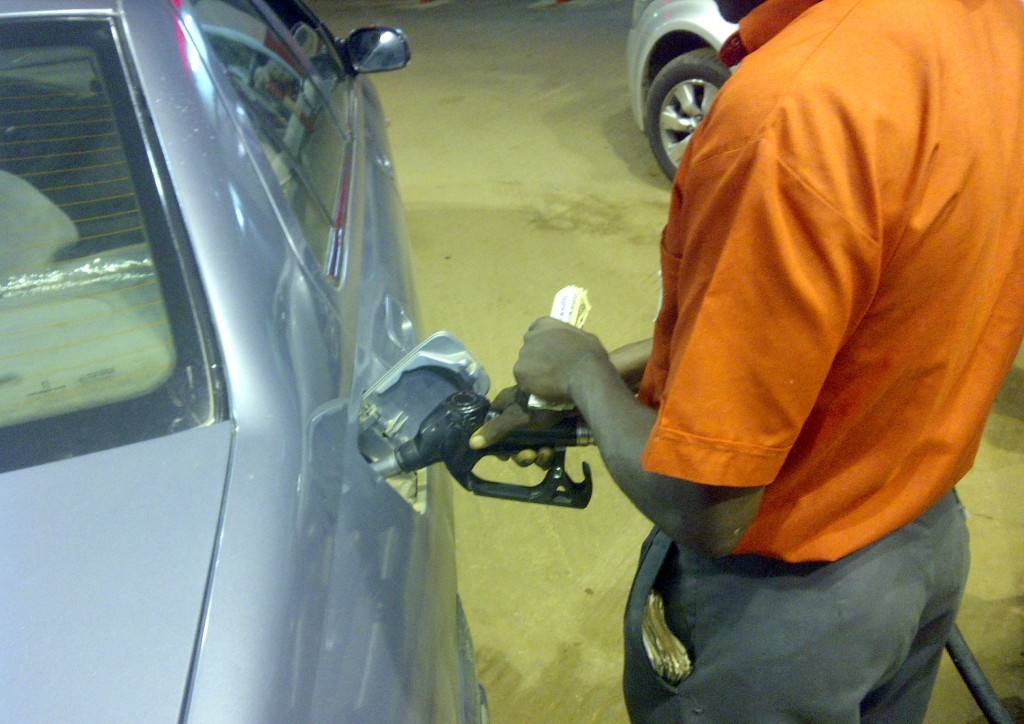
While the Federal Government in Nigeria is making efforts to completely deregulate the downstream sector of the petroleum industry that will see an increase in pump price of petrol from the current (official) N97 to at least N141 per litre, the Chinese Government has for the fourth time this year reduced the price of petrol for its motorists.
Starting from Friday, Chinese motorists will pay a reduced price for petrol and diesel. In China, price for petrol per litre has been reduced by 0.22 yuan (N5.5) while the price per litre of diesel has been reduced by 0.26 yuan (N6.6).
The price reduction is the fourth in 2012.
The regulatory National Development and Reform Commission, NDRC, said on Thursday in a statement that the cuts followed a drop in the cost of crude oil in the international market which was affected by the presidential election in the United States and the slow recovery of the global economy.
“International oil prices have tumbled. WTI and Brent oil futures dropped to $85 a barrel and $105 a barrel, respectively, as of the start of November,” the NDRC said in a statement on its website.
The cut which takes effect on Friday represents a decrease of 3.2% for petrol and 3.4% for diesel on the ceiling benchmarks of CNY9, 640/tonne and CNY8, 820/tonne respectively.
As at Wednesday, the value of China’s crude basket had fallen by 4.36% since September 7.
Under the country’s oil-product pricing system, which started in 2008, domestic fuel prices may be adjusted when the moving average of the basket of international crudes change more than 4% over the 22-working-day period.
China imports nearly half of its oil requirements and the NDRC determines the price of the products based on international market forces.
The NDRC last adjusted petrol and diesel prices on September 11 this year, adding CNY550/ tonne and CNY540/tonne respectively, to reflect rising international oil prices.
China’s system is a bit different from Nigeria’s. Though prices are adjusted based on international price of crude, the government still determines how much petrol and diesel are sold to the citizens to avoid exploitation by fuel stations.
The Nigerian Government has said it needs to completely deregulate petrol to make it readily available. Diesel is already completely deregulated and marketers choose how much they want to sell to motorists.
Monday, 24 September 2012
Sunday, 12 August 2012
FG tasked on Youth skill acquisition
The federal government has been called upon to refocus its attention on job creation if its current transformation agenda must be achieved and be meaningful to the people.
The Society for Youth Research in Nigeria (SYRN) in a press statement signed by its executive director, Mr Olawale Rasheed to mark the International Youth Day celebration also urged government to encourage skill training in youth for the success of its investment in power, agriculture, road revival and infrastructure.
The group observed that as the world celebrates International Youth Day there is urgent need for government to address the unemployment challenge through massive training and retraining of unemployed graduates and other categories of youth as government alone cannot employ millions of youth across the nation.
It said the National Youth Service Corps must expand its Agricultural Entrepreneurial Programme for some corps members. “the success recorded in the implementation of the programme can provide useful lessons for skill training in other sectors of the economy” it said.
The group posited that government at all levels should introduce a systematic skill acquisition programme for youth with a scheme for seed capital provision through the community banks. “Such skills should include trade skills after which the trained youth can set themselves up and even employed one or two young persons” it said
While commending government on its ‘You Win’ Programme, NYRN said the general feeling among youth development experts is that the project is not on a scale that can address the mass joblessness facing the youth.
However, it asked government to imbibe the Indian experience in mass re-skilling of about three hundred million unemployed Indians through a programme embarked upon by the Indian government and is today regarded as a shining example in youth sector internationally and which has served as a foundation for its growing prosperity.
Via Sunday Trust
Fuel subsidy fraud: FG, PDP panic as suspects threaten to expose deals
• Governors wade in to give suspects ‘soft landing’ • Proceeds allegedly used for 2011 polls • How PPPRA receptionist, firm director got into trouble
There is an uneasy calm within the ruling Peoples Democratic Party (PDP) over threat by some of the fuel subsidy fraud suspects to open up in court on what the cash was used for.
Some of the suspects are bemoaning their fate, wondering why they are being prosecuted as they were allegedly used as fronts to source funds for the 2011 general elections
It was learnt that some of the suspects allegedly spent the cash to sponsor governorship elections in some states.
Uncomfortable with the development, some PDP governors have waded into the travails of the embattled suspects. The governors have assured the suspects of what an insider described as “soft-landing”. They have also promised to fund the litigation cost of the suspects by hiring for them crack defence counsels.
The Economic and Financial Crimes Commission (EFCC) has so far arraigned 25 suspects (in two batches) in connection with alleged fuel subsidy fraud.
The first batch comprises seven companies and 13 individuals in relation to N13, 403,504,083billion.
The second group comprises five suspects.
Although the arraignment of the suspects was a bold statement by the government that there will be no sacred cows, the trial is causing some disquiet in the ruling PDP. The Presidency is said to be particularly bothered by the turn of events.
A reliable source, who spoke in confidence, said: “Some of these suspects were used as fronts by some businessmen, party bigwigs and a few government officials. In fact, there is a Sierra-Leonean among them and a confidant of a PDP chieftain went to secure bail for him.
“The only excuse the confidant gave is that the suspect is a friend to one of their children. But most people could read between the lines. I think the Sierra Leonean was just being protected to avoid opening of the can of worms.”
Though the source was convinced that a substantial part of the subsidy funds was used to fund the 2011 elections, he said this was without the knowledge of the Presidency. When the President got to know the magnitude of the subsidy fraud, he decided to take the bull by the horns, irrespective of whose ox is gored, he said.
“A syndicate within the oil sector came together to pool funds for the 2011 election to ensure that the PDP retained its firm grip of power. In fact, two or three of the suspects are known to some PDP governors as fronts in view of the roles they played in their election. The biggest challenge confronting these influential people borders on threats by some of the suspects to open up in court,” he said.
To opposition parties, however, the Presidency cannot claim not to know that the subsidy cash was being diverted to unworthy causes by people close to the PDP whose members were in charge of either the PPPRA or other agencies of the oil industry.
The Nation learnt that PDP chieftains are so worried about the backlash the trial of these suspects could have on the fortunes of their party in 2015 because some of them were innocent businessmen before they dabbled into politics to feather their business nest and became polluted.
“One of the suspects was alleged to have complained bitterly on why he had to be arraigned by the same PDP administration he had assisted to retain power in some states.
“The suspect also queried why he had to be singled out among other directors of his companies while others were shielded.
“Some governors have been trying to wade into the complaints by some of the suspects and how to ensure soft-landing for them. They seem not to know how to go about it, considering the fact that the subsidy scam has generated so much interest, including that of the international community. This has forced the governors to opt for Plan B by looking for crack defence team to handle the matter.
“Nobody could say whether the choice of crack lawyers would assuage the threats of these highly-placed suspects to open up or not when proper trial begins, “ he said.
A governor said: “There is no doubt that some of the suspects are known in power corridors unless we are all pretending. It is, however, courageous of the government to put them on trial to show to all that closeness does not amount to fraudulent acts.”
Fresh facts have, however, emerged on how a staff of the Petroleum Products Pricing and Regulatory Agency (PPPRA), Fakuade Babafemi Ebenezer, and a director with Akintola Williams Deloite accounting firm, Ezekiel Olaleye Ejidele, got into trouble over the fuel subsidy scandal.
According to findings, while Ebenezer was a Facility Receptionist/Clerk for PPPRA where products are discharged, Ejidele was in charge of audit. Both suspects operated with officials of the Department of Petroleum Resources (DPR) and other agencies at the ports where products were discharged.
EFCC sources said they were arraigned for allegedly signing some papers indicating that some products were discharged whereas investigation proved the contrary.
It was, however, learnt that some oil chiefs are asking why some other officials involved in the management of The Petroleum Subsidy Fund (PSF) who also authenticated documents by suppliers have not been arraigned
A former Commissioner of Police said the conspiracy over subsidy fund fraud could be deeper than what the media are reporting
He said: “The PSF management is a chain. Besides the PPPRA, others involved are the Federal Ministry of Finance, the Central Bank, the DPR, Budget Office, Petroleum Equalization Fund (PEF), and Oil Marketing Trading Companies.”
“All these so-called forged documents passed through many desks before payments were effected to the marketers. Where are those who managed these desks when the fraud was perpetrated?
“The principles of Petroleum Support Fund (PSF) are such that no single oil marketer could perpetrate fraud or divert funds without the collaboration of some people or desk officers in government.”
Via The Nation
Investors lost 10% of revenues to insecurity, corruption in Nigeria –World Bank
 Investors in Nigeria lost 10 per cent of their revenues to poor quality infrastructure, crime, insecurity, and corruption in 2011, the World Bank has said in its report for the year.
The assessment reviewed the experiences of over 3,000 business owners in the affected states with a focus on challenges associated with their businesses.
The World Bank assessment complements a similar study in 2007 that covered 11 other Nigerian states.
The report was launched in Abuja by the World Bank Country Director, Ms Marie Francoise Marie-Nelly, in company with the Minister of Trade and Investment, Mr. Olusegun Aganga, and the Governor of Anambra State, Mr. Peter Obi.
The Lead Private Sector Development Specialist, World Bank, Mr. Michael Wong, said the 10 per cent revenue loss recorded in Nigeria was twice as high as what obtained in South Africa, Brazil, Russia and Indonesia.
He said the study revealed that entrepreneurs’ biggest problem was epileptic power supply while access to finance and corruption followed in that order.
For instance, he said manufacturing firms lost about 4.3 per cent of their sales proceeds to power outage while companies operating in the services sector lost about 6.3 per cent to epileptic power supply.
The report, according to Wong, shows that companies in the manufacturing sector lost 2.3 per cent of their revenue while those in the service sector lost about 2.2 per cent to corruption.
He said, “The poor performance of Nigerian firms reflects many factors. This study focuses on constraints in the business climate and the serious costs they impose on Nigerian firms.
“Taken together, the total indirect costs of poor quality infrastructure, crime and security, and corruption amount to over 10 per cent of sales for Nigerian firms. This is twice as high as in South Africa, Brazil, Russia and Indonesia.
“Nigerian businesses’ biggest reported problem is the unreliable power supply. About 83 per cent of all managers surveyed considered electricity outages to be a serious problem-more than any other constraint.
“Firms of all sizes, in all states and sectors, report average power outages equivalent to eight hours per day. The average firm reported that outages cost them money equivalent to more than four per cent of sales. No comparator country experiences such severe business losses related to the power supply.”
The report also listed tax rates, cost of finance, micro economic environment, transport, tax administration and access to land as other areas that posed serious problems to entrepreneurs in the country.
The report also said that only 15 per cent of Nigerian entrepreneurs were women, adding that the figure was the lowest in sub-Saharan Africa.
It also revealed that more than half of manufacturing firms in Nigeria did not employ women, noting that nearly 70 per cent of small firms with loans had to pledge their personal assets as collateral.
The 202 page report said, “Five other areas of the investment climate were rated as serious problems by at least one-third of firms—tax rates and tax administration, the macroeconomic environment, corruption, and transportation.
“Manufacturing firms reported paying an average of 3.2 per cent of their sales in bribes – second only to electricity outages among the costs measured by the study.
“Large and foreign-owned firms were more likely than others to rate corruption an important constraint, although as many as one-third of microenterprises also affirm that informal payments/gifts are commonplace. Losses of goods during transit emerged as an important cost, especially for exporters and larger firms.”
But Aganga said the Federal Government had identified the grey areas raised in the report and had begun the process of addressing them.
He said that President Goodluck Jonathan was addressing the problem of power supply and that before the end of the first quarter of 2013, the country would start experiencing at least 16 hours of uninterrupted power supply.
He, however, said that despite the harsh investment climate, Nigeria still remained the preferred investment destination in the world.
via Punch
Noise Of Revolt: In Nigeria, The gods are dead – Jonah Ayodele
“This is undisputedly the best time to live in Nigeria. As the country rides into animal savagery and as its people wallow in the somber mourning of their evaporating future, one could be lured to conclude that the good old gods have finally made it to their ancestral grave. If the good old gods, Awolowo, Azikiwe and Balewa were to come back today to see the trail of deserters, the thick wall of perfidy, the surging hypocritic disciples who shout their names in vain, the estrangement among their true followers and the stark diminution in the power and status of regional progressive groups, they would probably observe with great sadness and characteristic forthrightness. Sadly, these gods are dead.
I have an usual aggressive appetite to abuse protocols when I am addressing political vultures back in Nigeria. I always do that not because I am a political activist of sort, and I don’t hope to become any soon. I always do that because the person who steals my blood to fill his pocket without considering that my blood will drain away from his pocket does not deserve my respect. But because this is a gathering of Nigerians in a foreign land, I stand to revive the spirit of protocols.
Illustrious members of the High Table and the Table not so high, distinguished assemblage of intellectual warriors whose umblical cords were buried on our troubled fatherland, notable and budding philosophers of great influence, highly reverred daughters and sons of Nigeria. It is my pleasure to be invited as one of the guest speakers in this interactive session put together by Nigerians in Johannesburg. I thank you all for putting the issue of Nigeria’s lost intellectual heritage on the front burner of discourse again. I am sure that the gods themselves would have nodded in satisfaction at the act of aeronautical daring that have carried me here today and that will take me back to Nigeria where I have to resume at work in less than 24 hours. In all, it means I have less than 28 hours to spend on a soil that has produced notable heroes of Madiba’s status while we are still in search of ours.
But how did I end up here? How did I get to philosophize in a strange land? How did a Chemical Engineering graduate like me from a University built with cocoa funds in the heart of Ile Ife get to be noticed by my intellectual gangsterism, muscle-flexing in the midst of great minds like you? How did Nigeria get to this stage? What did we do wrong? When did our handshake go beyond our elbow? How did we make an unripe mango look like apple? How come we often display our extravagant social lunacy around? Why do we keep running into discomforting irrelevance? Why do we celebrate excessive illogicalities? When did we miss the art of balancing and moderation? And why did our creativity go awry? How come we keep talking of the good old days and not good nowadays?
Finding answers to some of the above questions may not require any stretch of thought, since we are a witness to a great national unease, of human eruptions on a revolutionary scale and scope, of a fierce contention between man and a capitalist machine that no longer recognizes even it’s own, of a trans-societal struggle to bring to heels a world in which inequity and inequality among classes and tribes have assumed a staggering and idiotic proportion. As for me, I am a product of such ironic society, so blessed and so poor. While you ran away to another black man’s land, I stayed back to fight on your behalf.
To appreciate the present drama called Nigeria, we must look back to the defining moment deployed by the dead gods in its heroic possibilities. This must be done not in anger, but in hope, with a view of unravelling when and how our shoes refused to fit our legs; and with the hope of bringing the magic of the past to bear on the misses of the moment. These dead gods are notable chapters in our history, titans that contended with other titanic figures. Their greatness was defined by the greatness of the historical circumstances that threw them up, the greatness of the expectations, and, of course, the greatness of many historical personages that gave them a run for their intellect, often in open confrontation. It is an embarrassment of human riches; a genetic scandal that these gods could be so stupendously endowed.
Since these gods died, we have struggled to get a grip of ourselves, with blood soaked proboscis of Boko Haram promoting our departure to proceed apace. Since the demise of these gods, we have lost our intellectual productivity to mental laziness, such that we are now blessed with a president whose sense of judgment has forced us to question the quality of his academic claims. We are now bogged down at the level of clearing the intellectual debris of misconceptions we inflicted on ourselves, imagine when we said we voted a man, not his party. There is a big hole in our sense of philosophy. Without a good sense of philosophy, we may as well be prepared to wallow in this chamber of sorrow for a long time.
My penchant for devouring books has revealed to me that a country will continue to move without leaving a spot if its people are mentally sick, with zero ability to philosophize problems and think far beyond out of the box. But what we have in our hands are a people blessed with the memory of goat, they often antagonize intellectual output they can learn from. The trio of Awolowo, Azikiwe and Balewa engaged philosophy till themselves transformed into gods of philosophy.
By philosophizing, I do not mean stringing together witticisms and wise-sayings into a coherent worldview. I am talking of the capacity for conceptual formulation and rigorous abstractions; the ability for sustained intellection and logical speculation. So can the current crop of Nigerian leaders philosophize? With the reigning imbroglio in our current political peculiar mess, one may be forced to agree with Thomas Jefferson, a founding father and third president of America, when he noted about black men that “It appears to me that in memory they are equal to whites: in reason much inferior, as I think one could scarcely be found capable of tracing and comprehending the investigation of Euclid; and that in imagination they are dull, tasteless and anomalous”.
Now that our people are conquered and subjugated, we must place advertorials that we are in need of new gods since our good old gods have finally made it back to their ancestral graveyard. We are in dire need of gods, anointed messiahs that will be thrown up by our unfolding History 101. These gods may not be blessed with the gift of garb, they may be challenged in the faculty of eloquence and elocution. All we need are gods whose sense of philosophy will enable them to connect with the rage of the inarticulate masses in all their elemental portent. All we need the gods to say is to say nothing, we will join in.
Can you be the gods we are craving for? Can you be the Balewa of our time? Who among you is ready to masquerade Awolowo’s philosophy? Can any of you take the challenge that threw Azikiwe up? Who can be the commander of the angry Nigerian mob and it’s fatalistic foot soldiers? Who among you can go back home and become the mediating elites for the angry faithful mob since the direct rule of the masses is mobocracy not democracy? Or are we going to wait till the centre collapses and things fall apart?
If the gods are not among you, you need not worry yourself to force it. I know they will be eslewhere on the globe, for when the gods are ripe for worship, they will demand for sacrifice, sacrifice in form of votes. I hope to also be a part of such intellectual revolution, when intellectual gangsterism will not be seen as cerebral flamboyancy. Even when the gods are dead, the gods are still alive elsewhere.
Thank you.”
Being a text of speech by Jonah Ayodele Obajeun, delivered at the Soweto Gathering of Young Nigerian Thinkers in Johannesburg, November 12, 2011.
Jonah Ayodele Obajeun. Blogs @ www.obajeun.com.
Police can’t find $620,000 bribe cash
Where is the $620,000 bribe collected by House of Representatives member Farouk Lawan from businessman Femi Otedola?
The puzzle remained unresolved at the weekend, the government is set to file charges against the lawmaker.
Lawan was the chairman of the House adhoc committee on fuel subsidy probe. Also to be charged is the clerk of the committee, Mr. Borniface Emenalo.
The trial of the suspects may start without the cash as the government is bent on going ahead with the arraignment in the light of the weight of evidence at its disposal.
The Federal Government may file the charges this week, barring last-minute hitches.
The Anti-Corruption Network yesterday asked the government to also arraign Otedola, who said he handed Lawan the cash in a sting operation arraigned by security agents. Lawan accepted collecting the money but refused to surrender it, saying it is proof of Otedola’s pressure on him to remove the oil magnet’s company from the list of those indicted in the subsidy probe.
According to a source, the Special Task Force (STF) which investigated the case submitted its report to the Inspector-General of Police, Mohammed Abubakar and the Attorney-General of the Federation, Mohammed Adoke (SAN), without any trace of the bribe cash.
The source, however, claimed that “the evidence the police made available to the AGF were enough to sustain the prosecution of the suspects”.
The source added: “The STF team tried to locate the bribe sum, which is vital to the trial of the suspects, but it could not because of vested interests in the matter. This is a high-profile case with high-profile intrigues.
“But hope is not lost as there are other evidence ancillary to the fact that the bribe was given and taken.
“The prosecution may have to rely on some clips and statements made on oath by some of those interrogated. The STF did a good job and the investigation was far-reaching although without the bribe cash.
“With this investigation, you will appreciate that the Police did a thorough job.”
Asked if the police could determine whether the bribery was a sting operation or not, the source added: “A sister agency was involved and we presented the raw facts to the AGF which I cannot divulge.
“There are so many angles to this case; you have to wait for the trial to begin.”
A source said yesterday: “All hands are on deck to file charges against Lawan and Emenalo, pending the return of the lawmaker from the lesser Hajj.
“The two suspects may be arraigned before a high court by the government prosecutor this week.”
A source in the defence team said: “We are ready for the trial, let them go and file charges.”
Another source said: “As long as a sting operation could not be established by the police, the whole case will become flat.”
The Executive Secretary of Anti-Corruption Network, Mr. Dino Melaye, said the government should put Otedola on trial for the court to decide the guilty.
Melaye, a former member of the House of Representatives, said: “From what we have seen and heard, they have exempted the name of Mr. Femi Otedola from the list of those to be prosecuted.
“We are insisting that the three actors in the bribery saga (Otedola, Lawan and Emenalo) should be put on trial. The government should let the court determine whoever is guilty.
“Anything short of that, we are going to mobilise Nigerians against the trial of Lawan and Emenalo.”
Responding to a question, Melaye said the Network will resist plans to make Otedola a witness because “from police findings, they cannot call it a sting operation for lack of evidence.”
“If the government does not prosecute Otedola, it would amount to an attempt to water-down the case and acquit him.
“Nigerians are interested in this matter. Let the three suspects face trial and the proceedings of the court will enable them to have full insight into what transpired.
The choice of a Senior Advocate of Nigeria, Chief Adegboyega Awomolo (SAN), as counsel for the state is completely unacceptable because he is the one standing in defence of ex-Speaker Dimeji Bankole and a Judge in the case of an alleged N6billion fraud.
“So, there is actually a conflict of interest. A man who is standing against the state cannot at the same time prosecute for the state. You cannot approbate and reprobate at the same time. And public interest should be considered in this matter.”
Melaye said: “We will stage a protest. We have a stake in this matter.”
But a source said: “The truth of the matter is that Chief Awomolo withdrew from the defence team of the former Speaker. The Network should have done its homework very well.
“Also, Awomolo has been handling landmark cases for the Federal Government, including being a counsel to the Independent National Electoral Commission (INEC). He has a reputation that no one can tarnish at all.”
Subscribe to:
Posts (Atom)